

- City Hall & Service
- Learning & Togetherness
- Living & Future
- Discover & Experience

A positive outcome after six months
A look inside the bin makes a difference
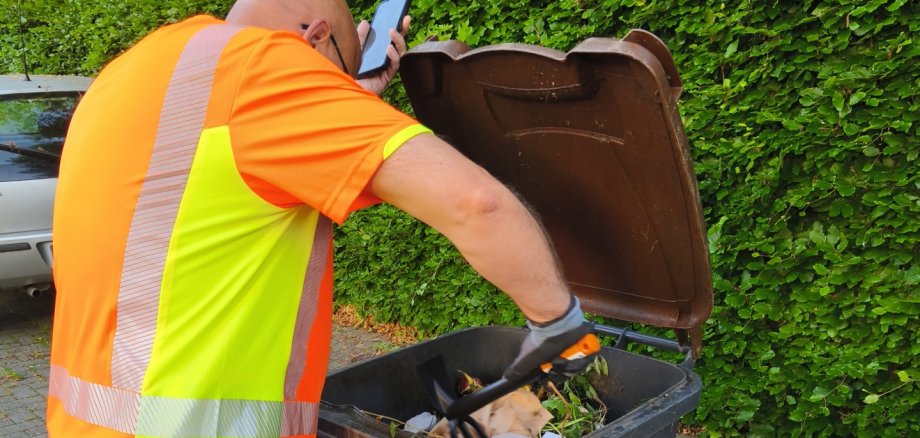
A quick peek under the lid is all it takes: is everything in order? Or is there a yellow or even a red card? For the past six months, this routine has been part of Heiko Prinz’s daily work. The organic waste bin inspector is out and about on collection days, taking a close look inside the bins that have been put out.
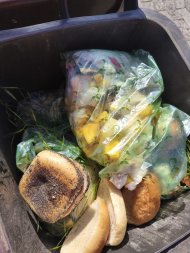
This bin has been filled incorrectly. Plastic bags do not belong in the organic waste bin.
Sometimes a quick glance is enough; other times he has to look a little more closely to spot any foreign matter. He often finds things amongst the potato peelings, coffee grounds and garden waste that don’t belong there: plastic bags, packaging or other foreign matter. That’s when the card comes into play. Yellow means: the bin will still be emptied, but a closer look should be taken the next time it is filled. Red means: too many foreign items – the bin won’t be emptied and must be sorted properly before the next collection.
For some time now, inspections of organic waste bins in Beckum have been an integral part of the waste management process; Heiko Prinz has been out on the streets on a regular basis since March. Six months on, AWG (Abfallwirtschaftsgesellschaft des Kreises Warendorf mbH) and the town of Beckum are taking stock for the first time:
In total, Heiko Prinz inspected 7,411 organic waste bins. 130 bins were given a yellow card and 226 a red card. His initial assessment is positive: “Of course, we still come across bins containing items that don’t belong there. But we’re noticing that the checks are having an effect. Many residents are now paying closer attention to what they put in them.”
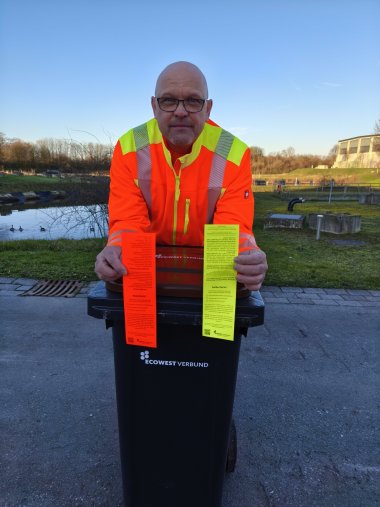
Heiko Prinz has little to complain about; if he does, he shows a yellow or red card.
This has also become apparent over the past few months. Whilst 11 per cent of the tonnes inspected were found to be non-compliant at the start, the figure has recently fallen to 3 per cent. “It’s not about handing out as many red cards as possible,” emphasises Prinz. “Ideally, at some point I won’t need to issue any cards at all.”
What may seem like a minor mistake can have major consequences. Plastic and other contaminants must later be sorted out, which involves considerable technical and financial effort. If too many foreign materials end up in the organic waste, the quality of the compost suffers.
Six months of organic waste bin inspections have shown, in the view of AWG and the town of Beckum, that the approach taken is the right one. The quality of organic waste has already improved. Heiko Prinz will therefore continue to inspect the bins – with a clear aim: as few foreign materials as possible and as many correctly filled bins as possible.
Fill the organic waste bin correctly
That belongs in there:
- Kitchen waste such as fruit, vegetables and food scraps
- Coffee grounds with a filter, eggshells and tea bags
- Garden waste such as wilted flowers, lawn and shrub cuttings, leaves and wild herbs
That doesn't belong in there:
- Plastic bin liners labelled as ‘compostable’
- Plastic and bin liners
- Disposable nappies and hygiene products
- Hoover bags, cigarette butts and ash
- Barbecue, oven and wood ash
- treated timber and street litter
- Leather, wool, hair, feathers and bones
- Flower pots and hydroponic growing medium
- Small animal and cat litter, as well as bird grit and animal droppings